Field Validation has seven rule types for the lines of a validation, plus a switch for dimensions in the header. This page helps you pick the right one. Start from what you want to enforce.
¶ Decision table
| I want to make sure that... | Use this rule | Validation Value | Example |
|---|---|---|---|
| A field is filled in | Mandatory | Empty | Phone No. on a customer |
| A field is in a list, above a limit or not a certain value | Filter | A Business Central filter | Credit Limit >0, Country/Region Code <>'' |
| Text or a code has a certain length | Length | min(10)..max(20) |
Phone No. of 10 to 20 characters |
| Text follows a pattern | Regular Expression | Empty (choose the expression) | Document No. starts with year and month |
| A value fits the date, the user or the company | Calculated | Empty (choose the calculated filter) | Order Date in the current accounting period |
| A field equals, or compares with, a field in another record | Related Field | Empty (choose relation and field) | Customer Posting Group on a sales order equals the one on the customer |
| A record has enough related records | Related No. of Records | A filter on the number | A customer has at least one sales price: >=1 |
| A record has the right dimensions | Validate Default Dimensions (header) | Not applicable | Department is mandatory on a customer |
¶ The rule types in a few lines
¶ Mandatory
Fails when the field is empty. Empty means the empty value of the field type: blank text, zero for numbers, no date. For a Yes/No field, No counts as empty, and for an option, the first option counts as empty. Start here for master data. See Quick start in 10 minutes.
¶ Filter
The field must pass a filter, written in normal Business Central filter syntax. Use it for numbers, dates, options and text. The filter is checked against the value of the field. For a text field, <>'' means not empty.
¶ Length
Counts characters in a Text or Code field. The Validation Value is always min(0)..max(10), with your own numbers. See The Length format.
¶ Regular Expression
For patterns that a filter cannot describe, such as a postal code or a document number. See Regular expressions and the cookbook.
¶ Calculated
Checks a field against a value that is worked out when the record is validated, such as the current accounting period, the signed-in user or the current company. See Calculated validations.
¶ Related Field
Compares a field with a field in a related table, using a table relation and a comparison (Equal, Not Equal, Greater than, Lower than, Greater or equal than, Lower or equal than). See Recipe 4: Related field check and Table relations.
¶ Related No. of Records
Counts the records in a related table and compares the number with the Validation Value. The option Execute validation on Related Table modifications is on by default for this type, so the rule also runs when the related record changes.
¶ Dimension rules
Turn on Validate Default Dimensions in the header to check the record against the global Default Dimensions settings of the table, such as a dimension with the value posting Code Mandatory or Same Code, and the allowed value filter. A dimension finding is shown on the results page with the type Dimension.
- On the validation, turn on Validate Default Dimensions.
- If Business Central finds no default dimension settings for the table, it offers to open the setup page. Choose Yes, and set them.
- Use Table Default Dimensions Setup in the ribbon of the validation to view or change the settings later.
Not every table allows default dimensions. For a table that does not, Business Central refuses the switch.
¶ Combine rules
A validation can have many lines, and all lines are checked every time a record of the table is modified. Combine rule types for one field, for example a Mandatory rule and a Regular Expression rule on the same field. Some patterns accept an empty value, so the Mandatory rule is what catches an empty field. See the traps in the regular expression cookbook.
¶ Regular expressions in Field Validation
A regular expression is a string of characters that defines a search pattern. In Field Validation you use it to check whether the value of a field has the right format, for example a phone number, a document number or a postal code. For ready-made patterns with examples, see the regular expression cookbook.
¶ Regular expressions list
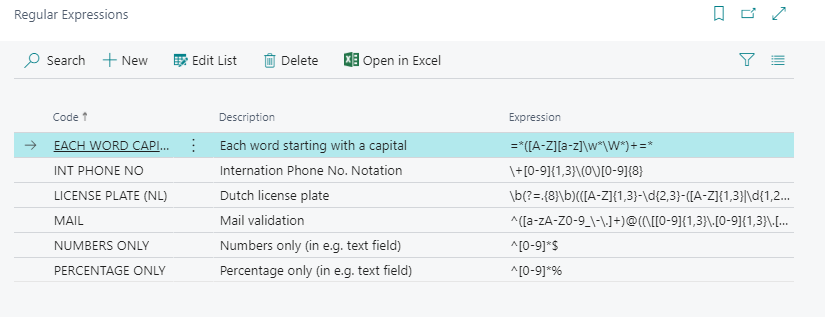
Search for Regular Expressions to see the list. The Load Default Data action on the Field Validation Setup page loads a standard set of six expressions, for example INT PHONE NO for international phone numbers. You can also add your own expressions on this page. Each expression has a Code, a Description, the Expression, a Test Value to try it out and an optional Default Notification.
¶ Test an expression
Type a value in Test Value. The value turns green when it matches the expression and red when it does not. Test with values that must pass and with values that must fail. Do this before you use an expression in a validation.
¶ Use a regular expression in a validation
The example below checks that the Phone No. of a customer is written in the international notation, for example +31(0)61234567. Business Central does not check this field itself, so the rule is the only check.
- In the validation line, select the type Regular Expression.
- Select the field that must be validated, here Phone No.
- In Regular Expression, choose the expression. Use the AssistEdit button to select
INT PHONE NO.
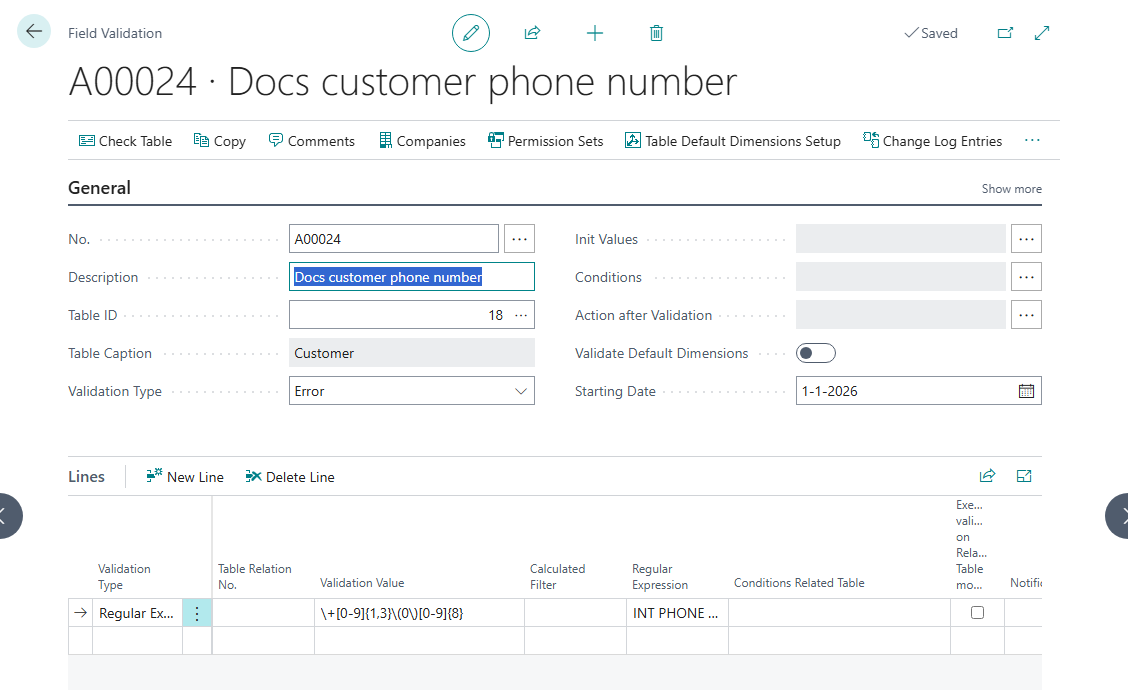
The finished line: type Regular Expression, the expression INT PHONE NO and its value.
When a user enters a value that does not match, the results page lists a finding with the message of the expression, or with the sample message "Field Phone No. does not match the required format", followed by the description of the expression.
¶ How the match works
- The expression is applied to the value as text, the same way it is shown on the page.
- It is case sensitive.
- It matches when the pattern occurs anywhere in the value. Start the expression with
^and end it with$if the whole value must match. - A value that is empty is checked too. Some expressions accept an empty value (for example
^[0-9]*$). Add a Mandatory rule when the field must be filled in.
These traps are explained with examples in the cookbook.
Business Central checks some fields itself before Field Validation runs. For example, it refuses an invalid value in the Email field of a customer, so a rule on that field never gets a chance to run. Use a regular expression on fields that Business Central does not check, such as Phone No. or a document number.
Remember that a validation is only active from its starting date, and that users must sign in again after you set one up. See When a validation is active.
¶ Copilot regular expressions generator
Designing regular expressions is complicated and takes time. From Business Central version 24.0 on, a Copilot can suggest the expression for you.
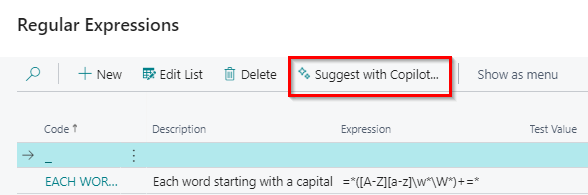
- On the Regular Expressions page, choose Suggest with Copilot.
- Describe in the prompt what the value must look like. The window explains how to build a good prompt. The Prompt guide next to Generate gives more help and a link to a demo video.
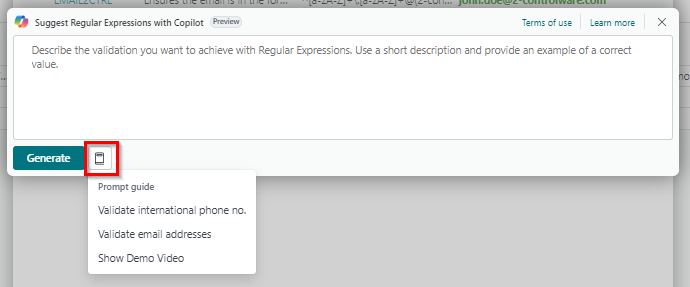
Be specific and give examples. For example: "Validate that a document number starts with the year and the month, then a dash, then at least one more character. Example: 202610-ORDER1."
- Choose Generate. Copilot proposes a regular expression that you can test right away.
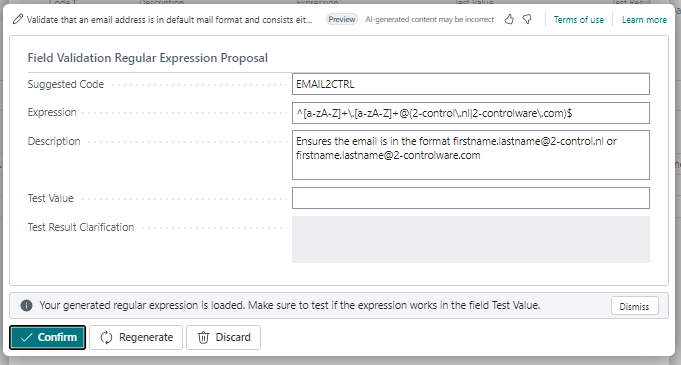
- Check the proposal and test it with a value.
- Choose Confirm to save the expression. Choose Yes when asked if you want to save it.
You can watch the demo video of the Copilot regular expressions generator on YouTube or on our media server.
¶ The proposal window
| Field or action | What it does |
|---|---|
| Suggested Code | The code Copilot proposes for the expression. You can change it before you confirm. |
| Expression | The regular expression for your prompt. |
| Description | A description of the expression. |
| Test Value | A value to test the expression. The value turns green when it is correct and red when it is not. |
| Test Result Clarification | Explains why a test value is not correct. |
| Confirm | Saves the expression so you can use it in a validation. |
| Regenerate | Generates a new expression. Do this when the prompt was not specific enough to give only one possible expression, and check the new suggestion. |
| Discard | Throws away the proposal and closes the window. |
| Dismiss | Closes the message "Your generated regular expression is loaded. Make sure to test if the expression works in the field Test Value." |
Copilot is a helper. Always test the expression with correct and incorrect values before you use it.
¶ Regular expression cookbook for Field Validation
This page gives you regular expressions you can copy into the Regular Expressions list, with values that match and values that do not. How to add and use an expression is explained in Regular expressions. Use the Test Value field on the list to try each example yourself.
¶ Read this first: three rules
- The pattern matches anywhere in the value. Without
^at the start and$at the end, an extra character before or after the pattern is accepted. - Matching is case sensitive.
[A-Z]does not accept lowercase letters. - An empty value is checked too. Patterns such as
^[0-9]*$match an empty value. Add a Mandatory rule on the same field when it must be filled in.
The examples were checked with a script that applies the same rule as Field Validation: a match anywhere in the value, case sensitive.
¶ The six default expressions
The Load Default Data action on the Field Validation Setup page loads these.
| Code | Expression | Matches | Does not match |
|---|---|---|---|
EACH WORD CAPITAL |
=*([A-Z][a-z]\w*\W*)+=* |
John Smith, Van Der Berg |
john smith, JOHN, empty |
INT PHONE NO |
\+[0-9]{1,3}\(0\)[0-9]{8} |
+31(0)61234567 |
+31612345678, 0612345678, +31(0)6123456 |
LICENSE PLATE (NL) |
\b(?=.{8}\b)(([A-Z]{1,3}-\d{2,3}-([A-Z]{1,3}\|\d{1,2}))\|(\d{1,3}-[A-Z]{2,3}-\d{1,3})\|([A-Z]{2}-([A-Z]{2}\|\d{2})-\d{2})\|(\d{2}-(\d{2}\|[A-Z]{2})-[A-Z]{2})) |
AB-12-CD, 12-AB-34, 12-ABC-3, AB-123-C |
AB1234, ab-12-cd, XX-YY-ZZ |
MAIL |
^([a-zA-Z0-9_\-\.]+)@((\[[0-9]{1,3}\.[0-9]{1,3}\.[0-9]{1,3}\.)\|(([a-zA-Z0-9\-]+\.)+))([a-zA-Z]{2,4}\|[0-9]{1,3})(\]?)$ |
john.doe@2-control.nl |
john.doe@contoso, john doe@contoso.com |
NUMBERS ONLY |
^[0-9]*$ |
12345, and empty |
12a45, 12 45 |
PERCENTAGE ONLY |
^[0-9]*% |
25%, % |
25, abc25% |
What each default really checks:
- EACH WORD CAPITAL matches when the value contains at least one word that starts with a capital followed by a lowercase letter. It does not check that every word does:
john Smithmatches. - INT PHONE NO needs the notation
+31(0)followed by exactly eight digits, for example+31(0)61234567. It is not anchored, so+31(0)612345678(nine digits) matches too. - LICENSE PLATE (NL) looks for eight characters in one of the Dutch notations. It is not anchored:
AB-12-CD-EFmatches because it starts with a valid plate. - MAIL accepts domain endings of two to four letters, so a valid address with a longer ending, such as
john@contoso.company, does not match. Business Central validates the Email field itself before Field Validation runs, so use this expression on other text fields. - NUMBERS ONLY matches an empty value.
- PERCENTAGE ONLY has no
$, so25%abcmatches.
¶ Traps
| Trap | Why | Fix |
|---|---|---|
^[0-9]*$ accepts an empty field |
* means zero or more |
Use + for at least one, or add a Mandatory rule |
[0-9]{8} accepts nine digits |
Not anchored: the first eight digits match | Put ^ before and $ after |
| Lowercase input is refused | [A-Z] is case sensitive |
Use [A-Za-z], or enter codes in capitals |
| A rule on a date or decimal field behaves unexpectedly | The expression is applied to the value as text, in the format of the page | Use expressions on Text and Code fields |
| A special character is not matched | Characters such as + ( ) . ? * have a meaning |
Put a backslash before them: \+, \(, \. |
| A field BC checks itself never reaches the rule | For example Email | Choose a field that BC does not check |
¶ New patterns
These patterns were tested with the examples in the table. Add them with New on the Regular Expressions list, and adjust them to your situation.
| Code | Expression | Matches | Does not match |
|---|---|---|---|
POSTAL CODE NL |
^[1-9][0-9]{3}\s?[A-Z]{2}$ |
1234 AB, 1234AB |
0123 AB, 1234 ab, 1234 ABC |
YEAR MONTH PREFIX |
^20[0-9]{2}(0[1-9]\|1[0-2])-.+$ |
202610-INV, 202612-A |
202613-INV, 202610, 2026-10-INV |
IBAN NL |
^NL[0-9]{2}[A-Z]{4}[0-9]{10}$ |
NL91ABNA0417164300 |
nl91abna0417164300, BE68539007547034 |
VAT NO NL |
^NL[0-9]{9}B[0-9]{2}$ |
NL123456789B01 |
NL123456789B1, NL123456789001 |
ITEM CODE |
^[A-Z]{3}-[0-9]{4}$ |
ABC-1234 |
ABC-12345, AB-1234, abc-1234 |
NO SPACES AROUND |
^\S(.*\S)?$ |
Contoso, Con toso |
Contoso, Contoso , empty |
PERCENT DECIMALS |
^[0-9]{1,3}(\.[0-9]{1,2})?%$ |
12.5%, 100% |
12,5%, 12.555%, 1000% |
Notes:
YEAR MONTH PREFIXis the pattern behind the document number rule in the release recipe: the external document number starts with the year and month.NO SPACES AROUNDalso refuses an empty value, so it works as a Mandatory rule as well.- The patterns use
[0-9]instead of\don purpose, so that only the digits 0 to 9 are accepted. - Postal codes, IBAN and VAT numbers are checked on their format only, not on whether they exist.
¶ Test before you use
- Add the expression on the Regular Expressions page.
- Enter a value that must pass in Test Value. It must turn green.
- Enter a value that must fail. It must turn red.
- Use the expression in a validation line with the type Warning first, and check the findings with Check Table.
¶ Calculated validations
A calculated validation checks a field against a value that is worked out at the moment of validation, not a fixed value. Use it when the right value depends on the date, the user or the company, for example an order date that must be in the current accounting period.
¶ What a calculated filter can use
A calculated filter has a Type:
- Date Formula: a date filter, written as a Business Central date filter, for example
pfor the current accounting period. - System Variable: the User ID, the User Security ID or the Current Company.
- Related Field: a value of the signed-in user in a related table. Choose a table relation that starts at one of three tables: User Setup (table 91, found by user ID), Resource (table 156, found by the time sheet owner) or User (table 2000000120, found by user security ID). Then choose the Filter Field whose value is used.
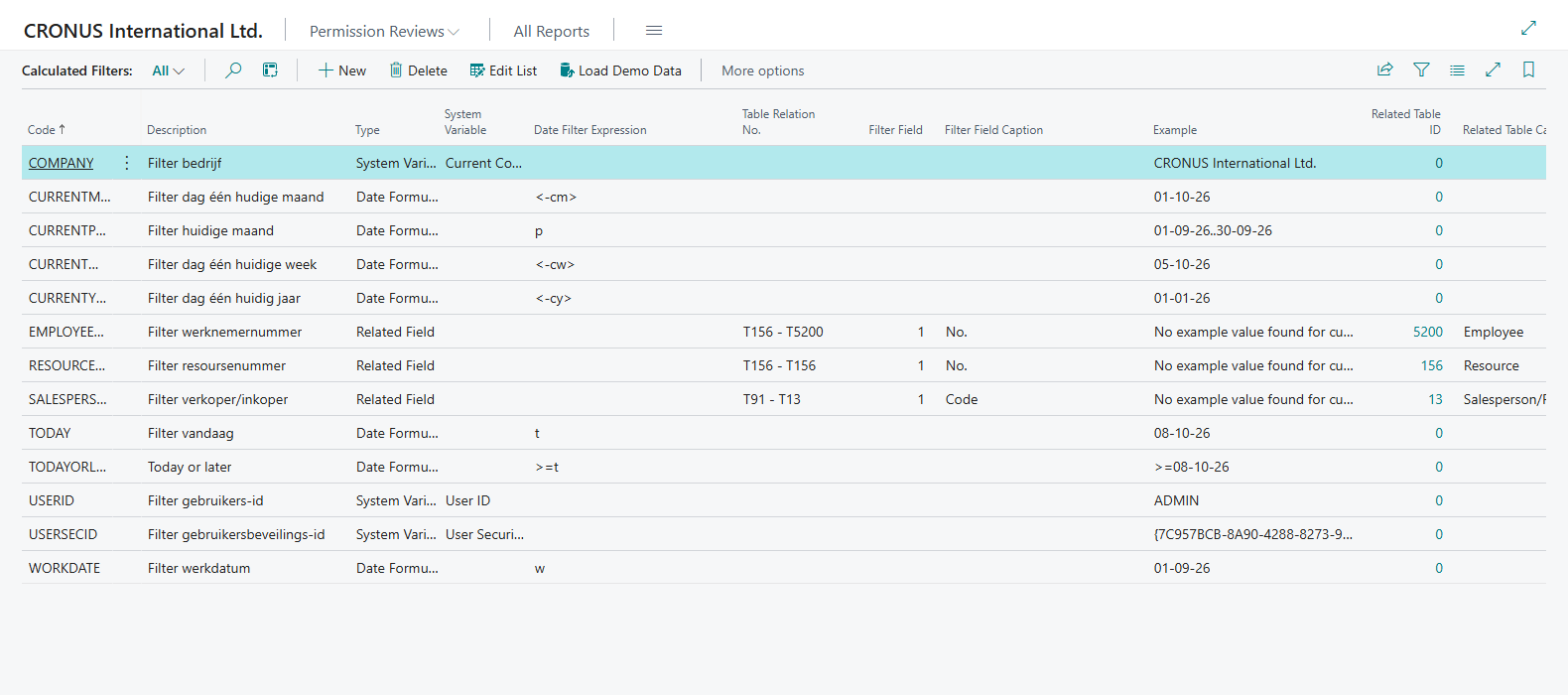
Search for Calculated Filters to see the list. The Load Default Data action on the Field Validation Setup page imports a set of calculated filters. You can add your own filters on this page.
¶ The default filters
| Code | Type | Expression or relation | What it filters on |
|---|---|---|---|
TODAY |
Date Formula | t |
Today |
WORKDATE |
Date Formula | w |
The work date |
CURRENTWEEK |
Date Formula | <-CW> |
Day one of the current week |
CURRENTMONTH |
Date Formula | <-CM> |
Day one of the current month |
CURRENTYEAR |
Date Formula | <-CY> |
Day one of the current year |
CURRENTPERIOD |
Date Formula | p |
The current accounting period |
USERID |
System Variable | User ID | The User ID of the signed-in user |
USERSECID |
System Variable | User Security ID | The User Security ID of the signed-in user |
COMPANY |
System Variable | Current Company | The current company |
SALESPERSONNO |
Related Field | User Setup to Salesperson/Purchaser | The salesperson or purchaser code of the user |
EMPLOYEENO |
Related Field | Resource to Employee | The number of the employee that is linked to the resource of the user. The relation matches the Resource No. of the resource with the Resource No. on the employee |
RESOURCENO |
Related Field | Resource to Resource | The resource number of the user |
¶ Day one versus the whole period
CURRENTWEEK, CURRENTMONTH and CURRENTYEAR each give one date: the first day of the week, month or year. Used on a date field, the field must be equal to that day. That is rarely what you want for an order date.
For a range, use CURRENTPERIOD. The expression p is the date filter for the accounting period that applies, so you get the whole period, for example 1 October 2026 to 31 October 2026 when your periods are months. It needs accounting periods that are defined for the date, so check Accounting Periods first. It is only "this month" when your accounting periods are calendar months.
| Code | Example result on Thursday 8 October 2026 |
|---|---|
TODAY |
8 October 2026 |
CURRENTWEEK |
5 October 2026 (Monday) |
CURRENTMONTH |
1 October 2026 |
CURRENTYEAR |
1 January 2026 |
CURRENTPERIOD |
1 October 2026 to 31 October 2026, with monthly accounting periods |
¶ Create your own calculated filter
- On the Calculated Filters page, choose New.
- Enter a Code and a Description, and set the Type to Date Formula.
- In Date Filter Expression, enter the filter, for example
<-CM>..<CM>for the first to the last day of the current month. - Check Example Date Filter. It shows what the expression gives today.
For a Related Field filter, choose the Table Relation No. and the Filter Field. Example Filter Field shows the value for the signed-in user, or says that no example value was found for the current user.
¶ Create a calculated validation
- Open the validation, or create a new one. See Create a validation.
- In a line, set Type to Calculated.
- Select the field that must be validated.
- In Calculated Filter, use the AssistEdit button and select the filter.
- Set a Starting Date of today or earlier, and sign in again.
¶ Example: order date in the current accounting period
The validation in this example works on the sales header. It has the condition that the status is Open, and one line of the type Calculated on the Order Date with the calculated filter CURRENTPERIOD. When the order date is not in the current accounting period and the order has the status Open or changes to Open, an error occurs.
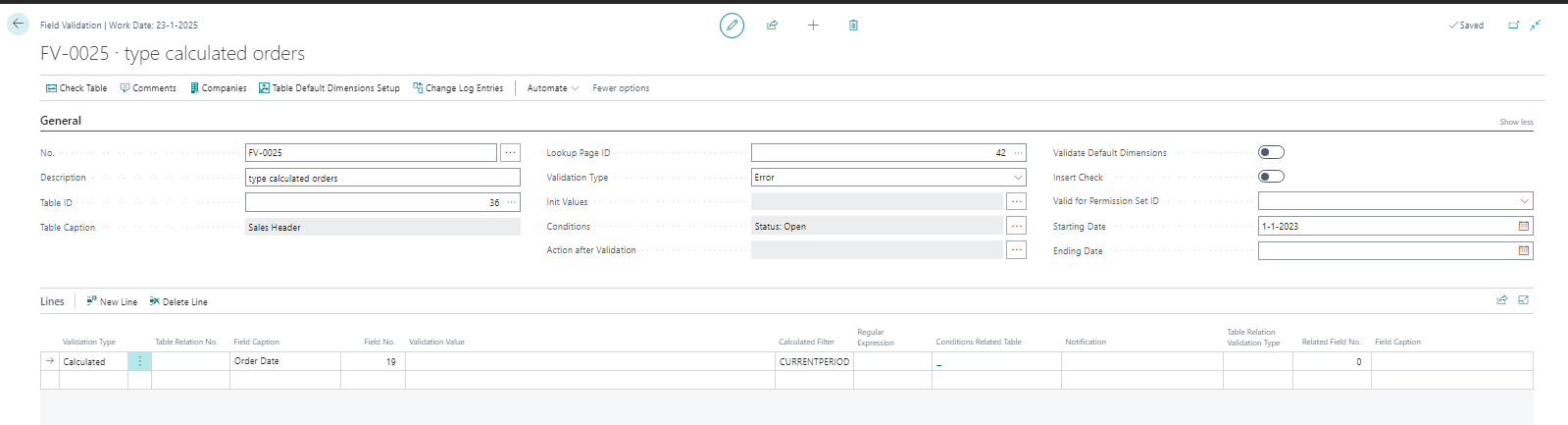
The default message says: Field Order Date must apply to Filter current month. That text is the description of the default CURRENTPERIOD filter. If your accounting periods are not months, write your own text in the Notification field of the line.
Remember that a validation is only active from its starting date, and that users must sign in again after you set one up. See Create a validation.
¶ Table relations
A table relation tells Field Validation how two tables in Business Central are related, for example a sales line and its sales header. With a table relation, a validation can use data from the related table in its conditions, its actions and its rules. This lets you, for example, check all lines of an order when the status of the header changes to Released.
When you choose Load Default Data on the Field Validation Setup page, a set of table relations based on standard Business Central is added. You can use them and study them as examples for your own relations.

¶ Create a table relation
- Search for Table Relations List and choose New.
- In No., enter a number for the relation. For a relation between the tables 39 and 14, you could use
T39-T14. - In the first Table field, choose the table you want to set the validation for. In the second field, Related Table, choose the table that is the source of the validation. The description shows the names of both tables.
- Business Central fills the lines with the fields that link the two tables (the primary key). Remove fields to base the relation on fewer fields, or keep all the fields that must be related.
- Optional: limit the records of the related table with a condition. Choose Conditions at the end of the line. In Field No., use AssistEdit to select the field to filter on, and enter the value in Filter. Choose Close.
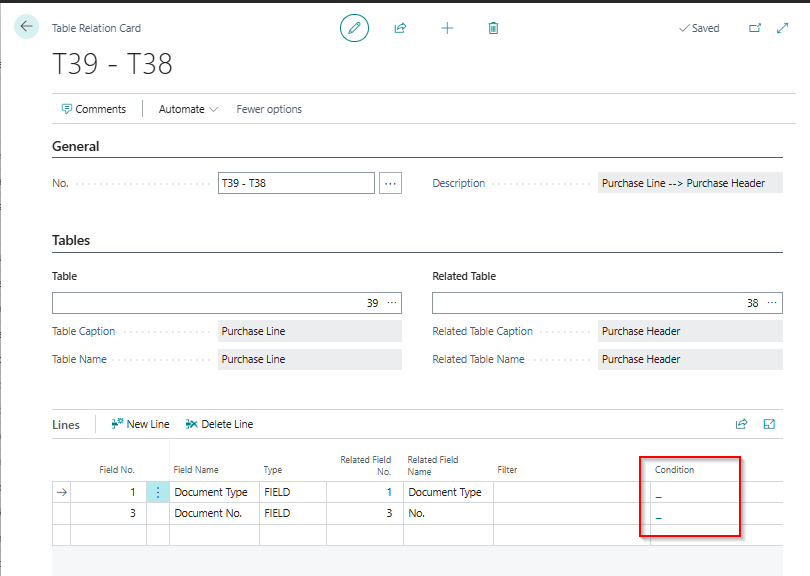
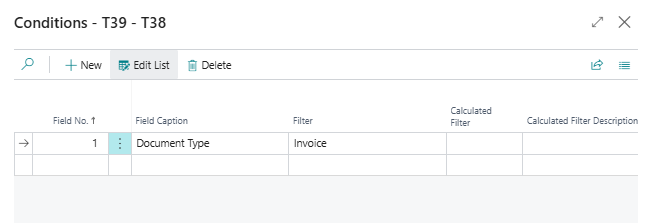
The result is a relation that you can select in the Table Relation No. field of a validation line, or in the conditions and actions of a validation.
¶ Conditions and constants
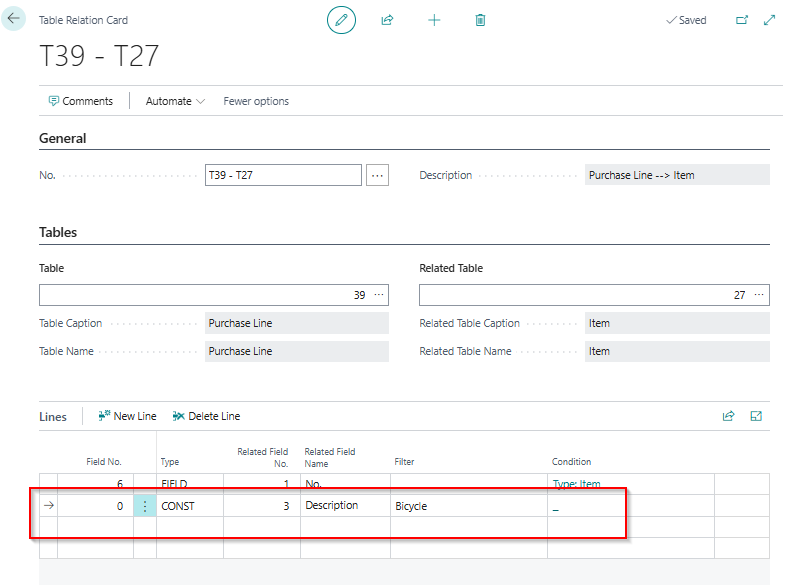
A line of a table relation has the type FIELD or CONST.
- FIELD links a field of the table to a field of the related table.
- CONST uses a constant instead of a field. Enter the field of the related table and the constant value in Filter. In the example below, the relation only applies to the item whose description is "Bicycle".
¶ Example: validate sales lines when an order is released
In this example, we want the type of a sales line to be Item and the description to be filled in. The validation is set up on the sales line (table 37) and uses a table relation to the sales header (table 36). It runs when the status of the sales header changes from Open to Released.
Standard Business Central checks only a fixed set of fields when you release a document. With a table relation, you set your own rules for the header and the lines, without code.
Transcript of this video
Validate sales orders at the moment they are released. Header and lines, without code. Before an order is released, the data must be right. The external document number starts with the year and month. The posting date is today or later. Name and address are filled in. And every item line has a quantity, a price, a location, and the right description. Standard Business Central checks a fixed set of fields on release. Your own rules mean custom code, for every rule. With Field Validation, you set these rules per table, without code. This validation is for the sales header, table thirty-six. The type is Error, so a record that breaks a rule is stopped. The key setting is the condition. The rules only run when the status is not Open, so a draft stays free to edit. The starting date switches the validation on. The lines hold the rules. A regular expression checks the document number: year and month, a dash, then anything. The posting date may not be before today. Customer name and address are mandatory. The same for the lines: table thirty-seven, the sales line. Only item lines are checked. And a table relation to the header gives each line the status of its order. With that relation, the line rules also run when the order header changes. A starting date switches it on. Quantity and unit price must be above zero. The description must equal the description on the item, a related field rule across tables. And the location is mandatory. Rules load at sign-in, so we sign in again. Now we test with an order that breaks the rules. We release the order. It is stopped. The header rules and the line rules both fire, and every problem is listed with the message we wrote. The user corrects the document number, the posting date, and the address. And then the quantity and the location on the lines. Release once more, and it goes through. The same works on any table, as a warning or an error, per company or permission set. Field Validation, by 2-Controlware. Better data, without code.
Video (3 minutes): validation rules on the sales header and the sales lines, set up with the validation type Error. A sales order that breaks the rules cannot be released. All findings are listed with the messages you wrote, and after the corrections the order is released.
The two variants share steps 1 to 4. They differ in the validation type and in what happens to the order.
- Create a validation for the table Sales Line.
- Add the rule lines. Here: a Mandatory rule on the field Description, and a Filter rule on the field Type with the value Item.
- Set the Conditions with the table relation from the sales line to the sales header: the field Status with the filter
<>Open. The validation now only runs when the header is not open. - Select Execute validation on Related Table modifications on the condition. Without this setting, the line rules do not run when the header changes, so they do not run on release.

When you enter a table relation, Business Central may ask for a confirmation ("Your change might update related records"). Choose Yes.
¶ Variant A: Error, as in the video
- Set the Validation Type to Error.
Release a sales order that does not meet the rules. The rules are checked, the findings are shown on the Field Validation Results page, and the release is reversed: the order stays open until the lines are corrected. This is the strictest variant and the one in the video.
¶ Variant B: Warning with an action
- Set the Validation Type to Warning.
- Set the Action after Validation: change the field Status of the related sales header to Open. If the rules are not met, the status of the sales header changes back to Open.
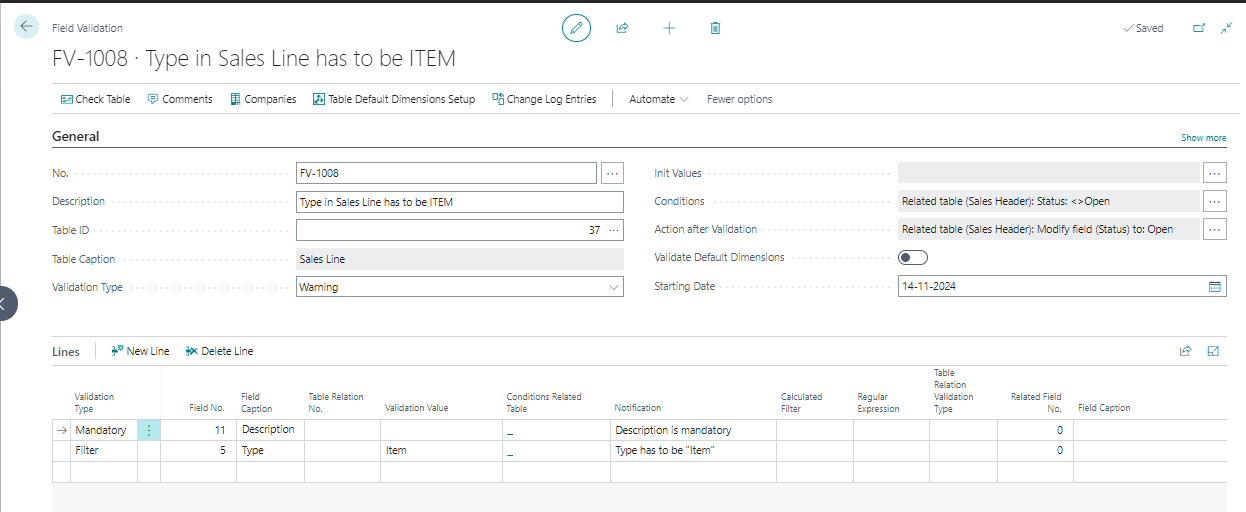
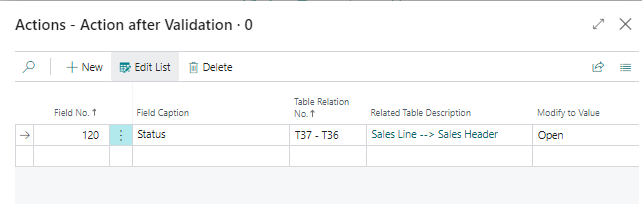
Release a sales order that does not meet the rules. The findings are shown on the Field Validation Results page. The user is informed, and the action puts the status of the header back to Open.
Action after Validation is only available with the validation type Warning. With the type Error, the modification of the record is reversed instead. See Warning or error.
For a complete example with rules on the header and the lines, see Recipe: block releasing a sales order.
Last reviewed: October 2026.