Compliance Field Security adds three kinds of control that standard Business Central does not have. Standard permissions work per table, so anyone who may edit a record may edit every field in it. Standard Business Central also cannot show a user only part of a table, and it cannot block one action on a page. Field Security closes these gaps, and the data owners can set up the rules themselves, without code.
¶ Why is it important
Standard permissions give a user a whole table, a whole page or none of it. Real work is finer: Anna may post the order but not change the payment terms, the salesperson may see only their own orders, and only the finance team may release. Field Security closes that gap, without code:
- Fewer mistakes and less fraud: critical fields such as posting groups or job titles can be changed only by the people who own them.
- Segregation of duties: you can split a table between departments, for example by document type, and block single actions such as Release.
- Data owners keep control: you set up the rules in Business Central, and the changes to your rules are logged. See Reference.
Transcript of this video
Compliance Field Security. Lock a single field. Anyone who may edit an employee can change the job title. Standard Business Central cannot protect just that one field. So the title is changed, and saved. Nobody is asked why, and nothing is stopped. With Compliance Field Security, you secure one field of one table. Here, the job title of the employee. Everything else on the employee stays editable. Only that one field is locked. You write the message people will see, so they know who to ask. And you choose who is locked out, by linking permission sets. After the next sign-in, the rule is active. Same user, same employee, same field. Now the same user tries the same change. It is refused, with the message you wrote yourself. Nothing is saved. Protect the fields that matter. Compliance Field Security, by 2-Controlware. Try it for thirty days.
Video (about a minute): a field is locked for one user, and standard Business Central permissions alone could not do that.
¶ How it works
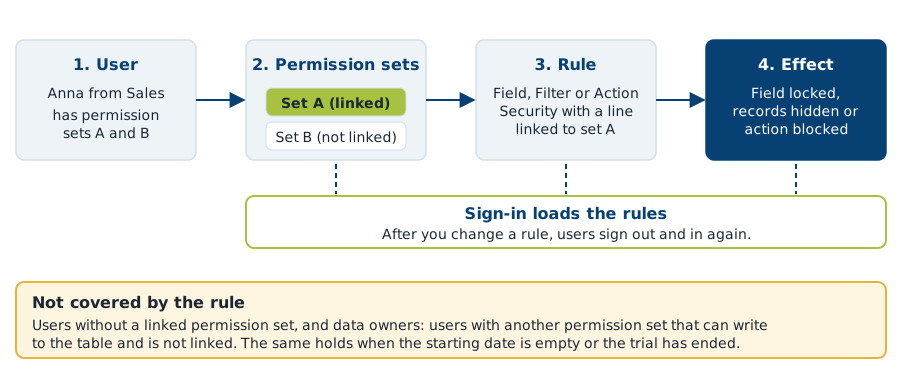
In short: you link a rule to permission sets. The rule applies to every user who has one of those permission sets. The rules are loaded when the user signs in.
Inside the app the three features are called Field Security, Filter Security and Action Security.
- Field Security locks fields for chosen users. Example: only Human Resources may change the Job Title on the Employee Card. See Lock fields with Field Security.
- Filter Security lets a user see, or edit, only part of a table, based on a filter. Example: a user sees only the employees of the Production department. See Hide records with Filter Security.
- Action Security blocks actions on pages for chosen users. Example: only the finance team may release sales orders. See Block actions with Action Security.
¶ What you can do
| I want to ... | Use | Page |
|---|---|---|
| Lock one field, such as Job Title, for most users | Field Security, Default Editable on | Lock fields |
| Let a user fill in a field once, but not change it afterwards | Field Security with Initial Field Entry Allowed | Lock fields |
| Allow users to edit only a few fields of a table | Field Security, Default Editable off | Lock fields |
| Hide the records of other departments | Filter Security, type Visible | Hide records |
| Let a user edit only the records that match a filter | Filter Security, type Editable | Filter Security |
| Show each salesperson only their own orders | Filter Security with a calculated filter | Filters |
| Block Release (or another action) for some users | Action Security | Block actions |
| Know who is covered by a rule, and who is not | Effective Securities | Effective security |
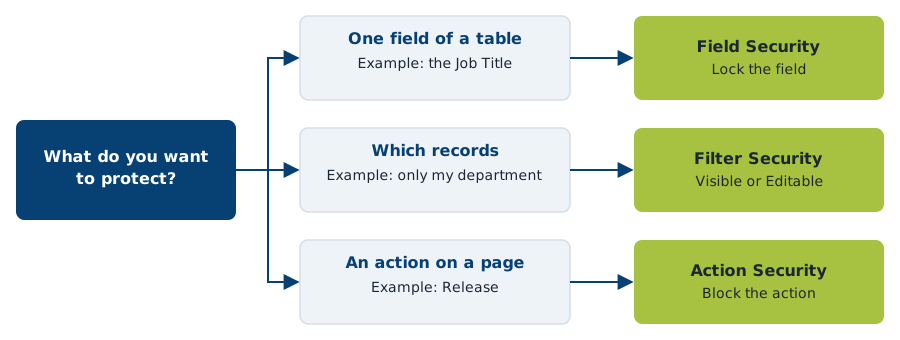
Not sure where to start? Follow the quick start on Set up.
¶ What you need
- Microsoft Dynamics 365 Business Central, online (SaaS) or on-premises. For supported versions see the release notes.
- The app Compliance Field Security. It depends on Compliance Essentials, which is installed with it at no extra cost.
- A registration after every new installation. You get a trial first, then you need a license. See Install and set up Field Security.
- The permission set
2C FIELDSEC MANAGEfor the people who maintain the rules. Every user needs2C FIELDSEC USE(what is this?). The setup wizard can assign it to all existing users. You assign it yourself to users you create later.
Without a valid trial or license the app does not apply your rules. See Limits before you rely on a rule.
¶ Where to go next
- Set up: install, register, link permission sets, a ten-minute quick start and the go-live checklist.
- Fields, Filters and Actions: the three features.
- Reference: how rules combine, setup switches, limits and notes for developers.
- Examples, including rules created with Copilot, and the FAQ.
Terms are explained in the Glossary. For general problems see Troubleshooting.
Last reviewed: October 2026.